
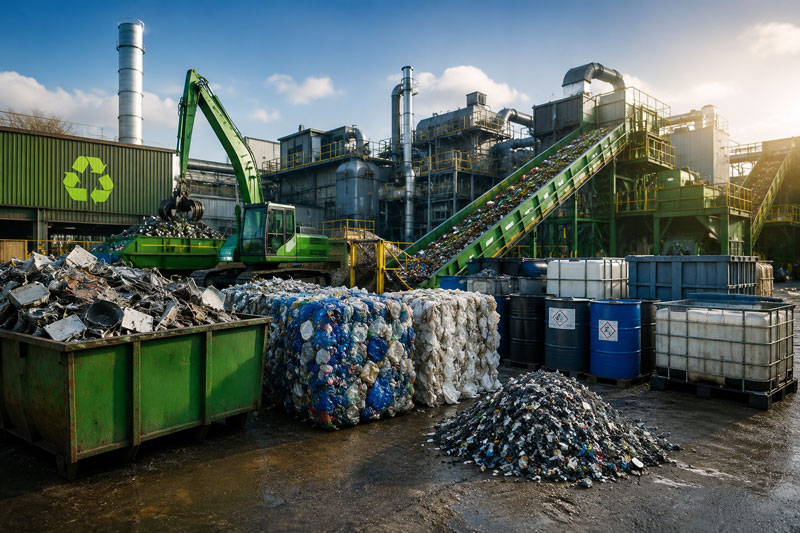
We are fully authorized for industrial waste management, holding all necessary approvals from the Central and State Pollution Control Boards. Our registration under the Extended Producer Responsibility (EPR) framework for CAT-I, CAT-II, and CAT-III ensures complete regulatory compliance for our clients.
Manufacturing drives India’s economic growth, but every production process generates industrial waste such as plastic scrap, rejected mouldings, packaging waste, e-waste, used batteries, damaged solar panels, and other by-products. While often treated as waste, many of these materials can be recovered and transformed into valuable resources through responsible recycling.
At Rexaw Recycling, we help manufacturers implement efficient waste management systems focused on resource recovery, regulatory compliance, and environmental responsibility. Our end-to-end services include waste collection, segregation, transportation, recycling, and complete compliance documentation.
Safety and compliance are at the core of our operations. Our facilities follow strict environmental and operational standards, ensuring every waste stream is handled responsibly while meeting CPCB, SPCB, and industry compliance requirements.
Leading companies across FMCG, automotive, pharmaceuticals, electronics, renewable energy, and manufacturing rely on Rexaw for dependable waste collection, recycling, and documentation, helping them stay compliant while building a more sustainable future.
Multi-layer plastic (MLP), used in chip packets, sachets, and laminated pouches, is among the most challenging types of plastic waste. Its bonded layers of plastic and often aluminium resist conventional recycling, which is why much of it has historically ended up in landfill, regardless of a brand’s intentions.
Rexaw partners with FMCG manufacturers to address this challenge. We collect MLP waste at the source and process it through dedicated recovery lines. Importantly, we do not treat the non-recyclable fraction as a dead end. Material that cannot be converted back into granules is instead used to produce Eco-Link
Plywood, a durable, weather-resistant alternative made from recovered plastic waste, suitable for shuttering, partitioning, and general construction.
For FMCG brands facing EPR requirements to demonstrate genuine end-of-life outcomes for their packaging, this solution is significant. It provides a tangible answer for the portion of packaging waste that most recyclers cannot process.
Most industrial systems have historically run on a straight line: extract raw material, manufacture, use, dispose. That model built a lot of industrial growth, but it also put steadily increasing pressure on natural resources and produced steadily increasing volumes of waste with nowhere good to go.
A circular economy works differently — keeping materials in productive use for as long as possible through reuse, repair, remanufacturing, and recycling, instead of treating “used” as synonymous with “finished.” Rather than letting recoverable plastics end up in landfill or in informal, undocumented waste streams,
proper recycling pulls that material back into active use as secondary raw material — conserving the resources that would otherwise have gone into producing it from scratch.
At Rexaw, this isn’t a sustainability tagline we’ve added to sound current — it’s the actual structure of our operations. Every tonne of material we recover is one tonne less reliance on virgin resource extraction, and every batch of granules or sheet of Eco-Link Plywood we produce is that same material staying in the loop instead of exiting it.
Extended Producer Responsibility (EPR) is a statutory framework that assigns responsibility for post consumer waste management to entities introducing products and packaging into the market. The Plastic Waste Management Rules, 2016, and the Plastic Waste Management (Amendment) Rules, 2022, notified under the Environment (Protection) Act, 1986, led the Central Pollution Control Board (CPCB) to establish a centralized EPR framework for plastic packaging. Under these guidelines, Producers, Importers, and Brand Owners (PIBOs) must register on the CPCB’s EPR portal and meet annual recycling and end-of-life disposal targets based on the quantity and category of plastic packaging they introduce.
The framework covers four categories of plastic packaging and requires entities to ensure that equivalent amounts of plastic waste are collected, recycled, processed, or disposed of through CPCB or SPCB authorized recyclers and waste processors. Compliance is demonstrated through digital documentation, traceability, and EPR certificates generated on the CPCB portal. Failure to meet these obligations may result in environmental compensation and other regulatory actions under the Environment (Protection) Act, 1986. EPR is therefore both an environmental commitment and a statutory business requirement. Similar frameworks now apply to other waste streams, including e-waste, waste batteries, used oil, and waste tyres, broadening producer accountability and supporting India’s move towards a circular economy.
We are Registered PWP (Plastic Waste Processor) with the State Pollution Control Board for Issuing Online EPR Credits (Cat I, Cat II and Cat III) through On-line Centralized Portal developed by Central Pollution Control Board and MoEFCC.
| Material | Status | Storage Requirement | Segregation | Recycling Path | Source Industries |
|---|---|---|---|---|---|
| PP Runners | Accepted | Dry, covered; separate from mixed scrap. | Yes — by colour. | Recycled in-house. | Injection moulding, Packaging. |
| PE / LDPE Film & Packaging | Accepted | Dry, covered; compact to reduce volume. | Separate from rigid plastics. | Recycled in-house. | Packaging, FMCG, Warehousing. |
| LLDPE | Accepted | Dry storage; protect from UV exposure. | Separate from standard LDPE. | Recycled in-house. | Stretch film, Agri film, Liners. |
| HDPE Drums & Containers | Accepted* | Store upright and fully drained. | Prior assessment if hazardous. | Recycled in-house after cleaning. | Chemicals, FMCG, Agrochemicals. |
| PET Preforms & Bottles | Accepted | Dry, covered storage. | Separate from coloured PET. | Recycled in-house. | Beverage & Packaging Manufacturers. |
| ABS Rejects | Accepted | Dry storage; avoid UV exposure. | Separate from engineering plastics. | Recycled in-house. | Automotive, Appliances, Electronics. |
| MLP (Multi-Layer Plastic) | Accepted | Dry, covered; free of food or liquid residue. | Separate from single-layer plastics. | Recycled in-house / Eco-Link Plywood. | FMCG, Food & Beverage, Personal Care. |
| Material | Status | Storage Requirement | Segregation | Recycling Path | Source Industries |
|---|---|---|---|---|---|
| Ferrous Metal Scrap | Collected & Channelized | Dry, covered; separate from non-ferrous metals. | Yes | Channelized to authorized recycler. | Manufacturing, Fabrication, Automotive. |
| Non-Ferrous Metal Scrap (Al/Cu/Brass) | Collected & Channelized | Dry, covered; segregate by metal type. | Yes — by metal type. | Channelized to authorized recycler. | Electronics, Automotive, Packaging. |
| Tetra Pak / Composite Cartons | Collected & Channelized | Dry storage; rinse if food residue is present. | Separate from standard MLP. | Channelized to specialized processor. | Beverage, Dairy, Food Packaging. |
| Material | Status | Storage Requirement | Segregation | Recycling Path | Source Industries |
|---|---|---|---|---|---|
| Electronic Assemblies (E-Waste) | Collected & Channelized | As per E-Waste Rules storage norms. | Yes — segregated at source. | Channelized to authorized E-Waste recycler. | Electronics Manufacturing, IT Hardware. |
| Lithium-Ion Batteries | Collected & Channelized | Fire-safe, non-conductive storage. | Yes — strictly segregated. | Channelized to authorized battery recycler. | Electronics, EV, Energy Storage. |
| Solar Panel Waste | Collected & Channelized | Stacked flat and protected from breakage. | Yes — separate from general waste. | Channelized to authorized solar waste processor. | Solar EPC, Renewable Energy Operators. |
Let’s Talk About Your Waste Stream
Whether you need support with industrial plastic scrap, EPR compliance, or specialized waste channelization, our team will guide you through our process.
Rexaw is among India’s foremost waste management and Plastic Recycling company.
© 2026. All Rights Reserved. Developed by CodeMax Media